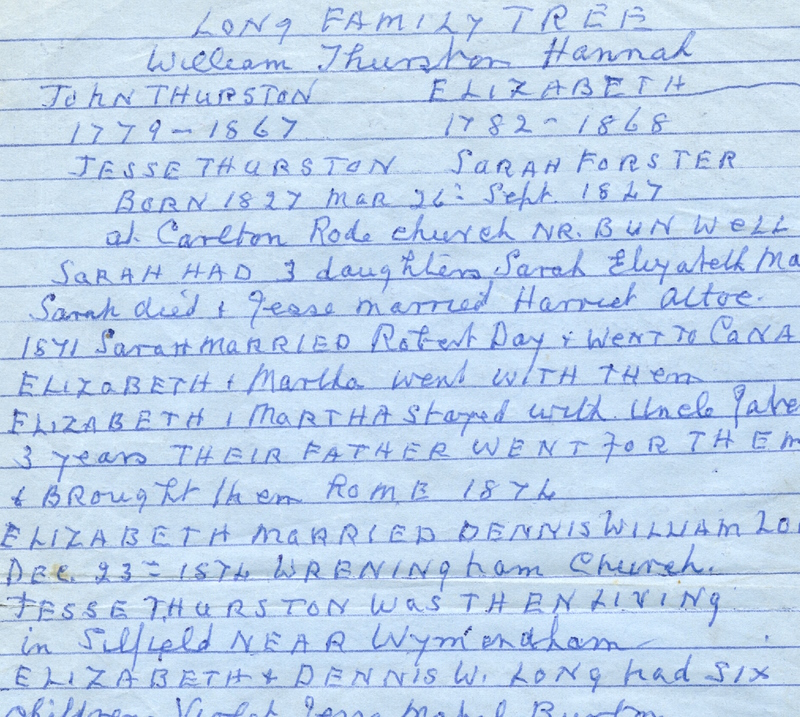
The strands of the Long family tree can be traced back to Bernie Long who had been born in Mulbarton in the late 1700s. His son, William Long, who married Charlotte Mays, was farming at Toprow by the time of the 1851 census. Their son, Dennis William Long was born in 1851.
Meanwhile, Jesse Thurston had married Sarah Forster at Carlton Rode in 1847 and by 1851, Jesse had become a farmer in Wreningham. They had three children: Sarah, Elizabeth and Martha. Jesse Thurston’s sister, (also named) Martha Thurston, went to work at Burton’s Farm and, in 1871, married John Bullimore.
Jesse Thurston’s daughter, Sarah, married and she moved to Canada with her new husband. The two sisters, Elizabeth and Martha went with them. About two years later, Jesse visited Canada and persuaded both his unmarried daughters (Elizabeth and Martha) to return home and, in December 1874, Elizabeth married Dennis William Long at Wreningham Church.
Dennis William Long and his wife Elizabeth had 6 children: Violet, Jesse, Mabel, Burton and Victor. (The last of these had the full name Victor Dennis Long.) The whole family moved to Fir Grove in 1889 when Dennis William Long became the tenant farmer. In 1912, they were able to purchase the farm.
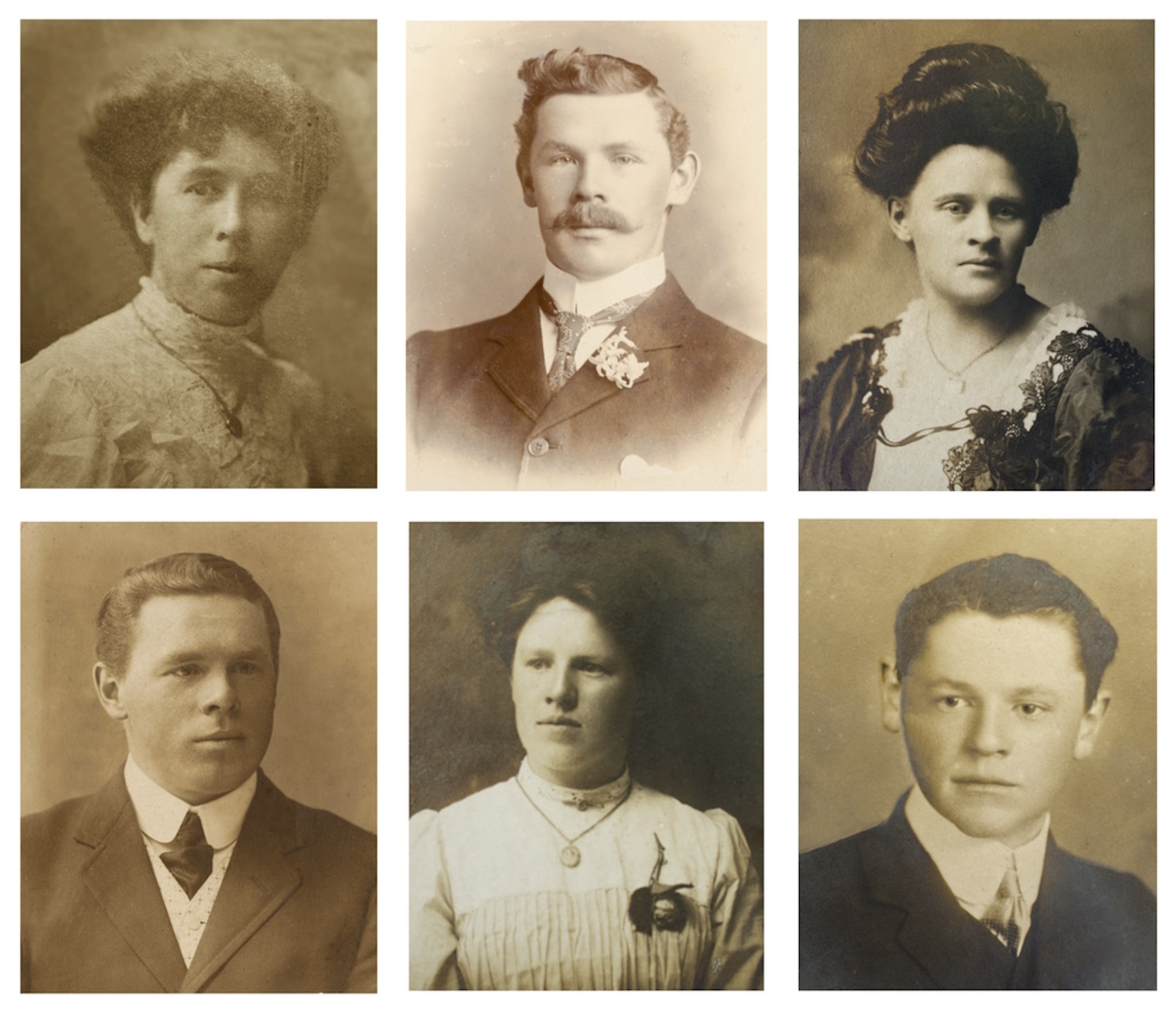
Mabel Long – organist
Mabel Long (top right in the above photos) made a name for herself in Wreningham by playing the Organ in the church for 57 years – taking over the role from Emma Upcher after the latter left the village in 1896 when her father, the rector, had died.
In Robert Dennis Day’s ledger there is a 26th December 1899 entry for Mabel buying 40 bills (fliers), 200 tickets and 150 programmes for a concert. The cost of the printing was 12s and, considering the date, we might presume the event was a special concert celebrating the 1900 New Year. There is also a note against the ticket printing which states “3 sittings”. Perhaps this concert was taking place in the (still very compact) school building? Directly below R D Day’s ledger entry showing his printing costs was a further item: “repair of music stool”!
On the 9th October 1901, Robert Dennis Day printed a further 50 bills plus 100 programmes for another Mabel Long concert. The lesser printing task only costing her (only) 6s, this time – and presumably held following the success of the previous concert? The good news is that the music stool didn’t need any further work; presumably R D Day’s earlier repair had been a success.
In 1906, members of Wreningham church made a presentation to Mabel as a token of appreciation for her completion of 10 years as a “voluntary organist”. The accompanying document was signed by nearly four dozen church members – the list being headed by Canon Fardell.
An old pocket book from 1909, branded by Hadfield’s Fertilizers of Liverpool was found at Fir Grove. It contains (presumably, traditional?) hand-written recipes and potions for treating horses. The hand-writing is assuming to be a “Long” family member from the period (Dennis William Long?). The treatments are titled variously:
How to “clean horses out”
How “to make a horse follow you”
“Recipe for the mange”
… and so on …
Each recipe lists the component oils and other ingredients together with the instructions for their preparation and use. We have no idea about the modern-day advisability of applying any of these treatments so will defer from providing any of the details!
Burton Bullimore Long (bottom left in the above photo group) moved to the 100 acre High House Farm – initially as the tenant, at the begining of the 1900s. He lived there until his death, in 1957. At the start of the 1950s he gifted an area of land in Mill Lane for the construction of the (first) Village Hall.
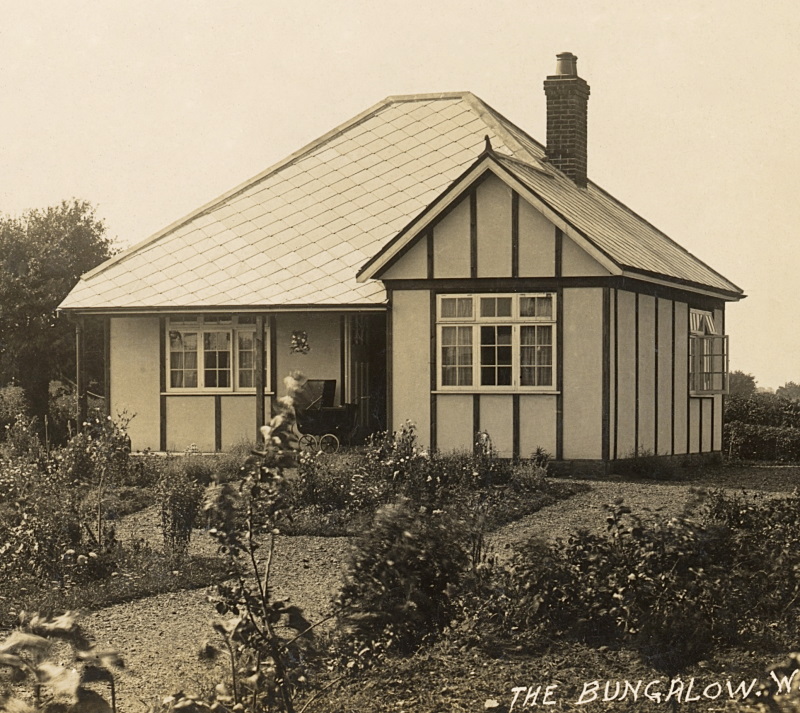
Dennis William Long and his wife, Elizabeth died in 1932 and 1933 respectively. At that point, son Victor and his wife, Marjorie, and family moved into Fir Grove. Simultaneously, Mabel and Minnie Long moved from Fir Grove to “The Bungalow” in Hethel Road; Mabel died in 1956 and Minnie in 1972.
Marjorie Long, who died in 1954, had been a key member of the WI, the church council and the local Red Cross. Victor Long followed her to the grave in 1956.
Victor’s son, Dennis Arthur Long became the new family stalwart.
Amongst other things, he was secretary of the Home Guard Comrade Club, a Jubilee Committee member, play/pantomime director, a churchwarden and (after Mabel Long) a church organist for over 50 years.
He also took control of the family farm at Fir Grove. Not least, he was the master-mind in the creation of Long’s Wood; a legacy for the people and the environment.